

Australian Centre for the Moving Image (ACMI) Wayfinding and Signage System
Project Background: Located in Federation Square, Melbourne, ACMI is the world’s first museum dedicated to the moving image (film, television, digital media), housed in a deconstructivist-style building with a geometric metal façade.
Design Focus: Centered on the “visual translation of the moving image,” the system reflects the architectural style and conveys the qualities of “fluidity and diversity.”
Wayfinding and Signage System Design Description
I. Design Philosophy
Centered on the concept of “flowing visual symbols,” the wayfinding system deeply echoes ACMI’s identity as the “Museum of the Moving Image.” Through sharp geometric shapes, high-saturation rainbow-colored layering, and dynamic electronic elements, it translates the characteristics of “image, motion, and diversity” into a visual language. The system also serves as a clear visual anchor within the complex architectural environment of Federation Square, enhancing visitor navigation efficiency and immersive experience.
II. Core Design Features
Continuity and Reflection of Architectural Language
The geometric cut-out forms of the wayfinding system (such as the angular edges and layered colors of outdoor landmarks) perfectly echo the deconstructivist metal façade of ACMI’s building (featuring diamond and triangular modules), integrating signage and architecture into a cohesive visual whole.
The “faceted” design of outdoor freestanding signage mimics the building’s geometric texture, while the layered colors (orange, yellow, green, blue, purple) reflect the dynamic color shifts of moving images, reinforcing the “moving image” theme.
Dynamic Recognition Through Color Coding
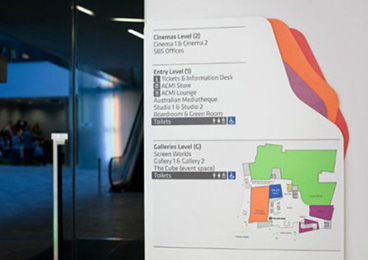
High-saturation rainbow colors are used to distinguish functional zones: orange for cinema, green for exhibitions, and purple for education. The overlapping and flowing effect of colors simulates the dynamic quality of imagery, allowing visitors to quickly identify areas without relying on text.
Colored edges on indoor signage (e.g., rainbow-colored accents on stairwell signs) create visual focal points in minimalist spaces, guiding movement while conveying a sense of energy.
Modular Information Hierarchy
Outdoor Landmarks: Large freestanding signs feature the ACMI logo and geometric color blocks, complemented by electronic screens displaying moving image previews, serving both as navigation tools and dynamic exhibition elements.
Indoor Wayfinding: Floor plans and functional guidance use color coding and geometric shapes (e.g., green for exhibition halls, orange for cinemas), ensuring clear information hierarchy. The angular forms of signage panels continue the architectural language, reinforcing spatial cohesion.
Multi‑Sensory Interactive Experience
Some signage integrates dynamic electronic screens (e.g., information displays on outdoor landmarks) that showcase exhibition previews and video clips in real-time, turning wayfinding into an extension of the “moving image” and deeply aligning with the museum’s identity.
The visual impact of colors and forms enhances visitors’ sense of discovery, particularly appealing to younger audiences and families.



III. Materials and Craftsmanship
Outdoor Signage: Weather‑resistant aluminum panels with fluorocarbon coating. Geometric forms are achieved through laser cutting and panel assembly, with precisely aligned colored metal plates for the layered sections, suitable for Melbourne’s maritime climate.
Indoor Signage: Acrylic with UV printing, offering vibrant colors and durability. Electronic screens use high‑definition LEDs, supporting dynamic content updates to accommodate the museum’s rotating exhibition needs.
Craftsmanship Details: Text and graphics are created with laser engraving and UV curing for strong color adhesion. Edges of geometric forms are finely polished to enhance a modern, high‑quality feel.
Ⅳ. Functional Value
Visual Anchor: Within the complex architecture of Federation Square, the highly recognizable wayfinding system serves as a core navigational reference, significantly improving accessibility.
Brand Reinforcement: Colors and geometric forms deeply reflect ACMI’s “moving image” brand identity, strengthening the museum’s visual recognition and memorability.
Experience Enhancement: Dynamic screens and color coding transform wayfinding from a mere “guidance tool” into an “interactive experience,” elevating visitors’ exploration and immersion.
Operational Flexibility: The modular design supports rapid updates of exhibition information, adapting to the museum’s dynamic operational needs and reducing long‑term maintenance costs.


