

Tamatsukuri Kindergarten
I. Design Concept
Centered on “Learning Through Play Wayfinding”, the system transcends the functional limits of conventional signage and transforms into a play partner within the kindergarten space. With rounded forms, vibrant colors, and interactive details, it allows children to naturally absorb information while exploring the environment, stimulating curiosity and imagination.


II. Core Design Features
1. Tubular Modular Visual Language
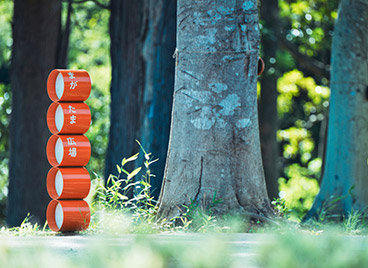
Using orange-coated metal tubes as the primary medium, a full range of wayfinding units—including outdoor landmarks, indoor guides, and information signs—are created through cutting, stacking, hanging, and other versatile forms.
The rounded tubular design eliminates sharp edges to meet child-safety requirements. The high-saturation orange serves as a strong visual anchor among trees and buildings, helping children easily recognize directions.
2. Child-Friendly Information Expression
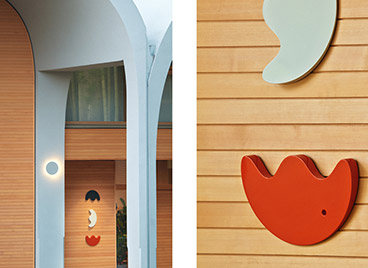
Text appears in a handwritten style, paired with cartoonish graphic elements (such as emoticons on clocks and abstract animal shapes for entrance signs), making information delivery warm and approachable.
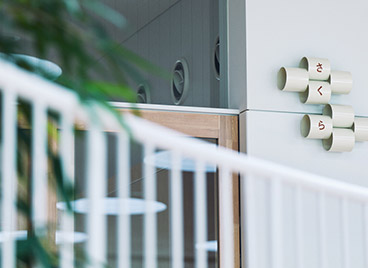
Outdoor stacked tubular signs (e.g., Magatama Plaza) evoke a “building-block” aesthetic to enhance playfulness. Indoor wall-mounted tubular signs (e.g., Staff Office, Pool) use color to distinguish functional zones.
3. Scene-Adaptive Spatial Narrative
Outdoor areas: Orange tubular landmarks line paths and stairs, acting as both directional guides and visual focal points in nature. The campus map features rounded corners and soft outlines, reflecting a childlike spatial perception.
Indoor areas: Tubular signs are integrated into the architecture via hanging or wall mounting, creating material contrast with wooden walls and white ceilings. Clock installations include emotive elements to make time awareness lively and engaging.
4. Integration of Local Context and Educational Value
Signage text incorporates local cultural references (e.g., Kofun referring to the ancient burial mounds in the Tamatsukuri area), turning wayfinding into a mini classroom for local culture.
The detachable modular design supports flexible updates to match teaching scenarios, enabling the growth-oriented evolution of the wayfinding system.
III. Materials & Craftsmanship
Main materials: Weather-resistant metal tubes (fluorocarbon coating) for exterior use; PVC tubes and acrylic for interior applications, ensuring durability and color stability over time.
Craft details: Text and graphics use screen printing + UV curing for strong color adhesion. Tubular units are precisely cut and assembled to guarantee rounded forms and structural stability.


IV. Functional Values
Experience Enhancement: Wayfinding becomes a “play clue” for children’s spatial exploration rather than cold instruction, boosting joy and a sense of security in the kindergarten environment.
Educational Empowerment: With local cultural elements and playful design, the system acts as a hidden educational tool to develop children’s spatial awareness and cultural sensitivity.
Brand Consistency: The orange tubular language runs throughout the campus, strengthening visual identity and creating a unique brand memory for Tamatsukuri Kindergarten.


